
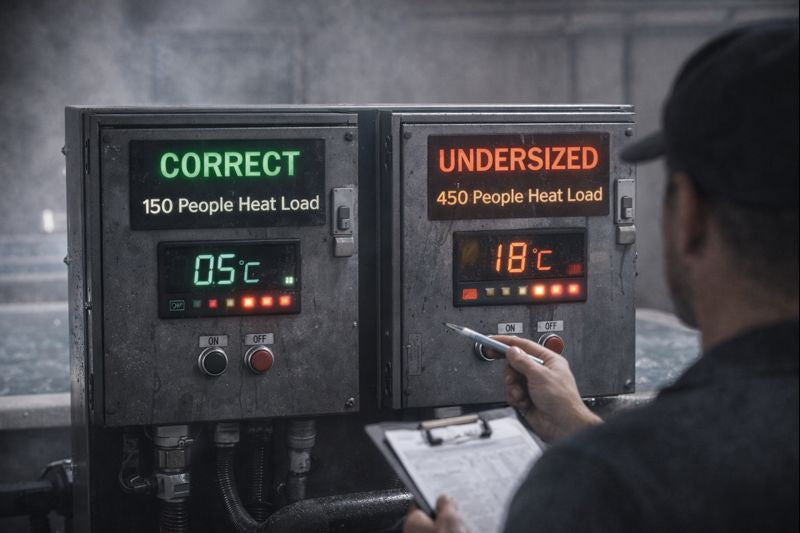
Sizing a chiller correctly is one of the most important aspects of running a recovery space.
If it's too small, at best it'll hit temp overnight and then slowly rise throughout the day.
At worst, and as happens most often, it never hits temp and is on a constant breakdown cycle because it's working at max capacity 24/7.
There are two main areas constantly fighting against correct sizing of a chiller.
1 - The advertised specs on chillers are wildly inaccurate
2 - People size based on daily visitors, not total heat load
For easy numbers, let's say you have 100 people per day coming through your facility.
The obvious solution seems like sizing for 100 people a day.
The issues with that, most people don't just use the ice bath only once.
They do contrast therapy.
They'll go from sauna/hot pool 2-3 times.
So that 100 people at the start is now 200-300 heat loads.
Just on this alone, that's enough to shoot your pool temp well above 15 degrees with no chance of return.
Then we have to add in the extra heat load from sauna/hot pool use.
Someone coming from the sauna for example adds an extra 50% more heat per cold plunge as opposed to someone who didn't.
So now those 200-300 heat loads become 300-450 heat loads in a day.
I don't have to tell you how much of an impact that makes on the water temp.
When I explained this to someone a few months ago, the way they made sense of it was - imagine if you invited 100 people to a wedding, catered for that many, then all of a sudden they each brought two to four guests.
There's nowhere near enough to go around and people are leaving disappointed.
The takeaway:
When sizing a chiller, the formula is this.
Daily visitors x 3
If you have hot/cold therapy, multiply that by 1.5
That's the heat load you need to size for.
One note to add to this - there are other heat loads such as ambient heat, solar, insulation etc - but swimmer volume is the most important.
Share:
The $28,600 Mistake Everyone Makes: Why "Cheap" Chillers Cost More
The Hidden Condensation Problem Destroying Recovery Spaces